The Vested Parimutuel
Settling prediction markets by time priority of capital at risk
Raj Karia · Hunch Research · Second edition, September 2026 · playhunch.xyz/vpm-whitepaper
Every dollar that arrives belongs to whoever was already on the other side.
In sixty seconds
A parimutuel pool works from the first dollar with no market maker, but it pays the same multiple to someone who was right three seconds before the whistle as to someone who was right an hour out. Venues cope by closing entry before the event.
This paper changes one moment. The losing pool is assigned at entry instead of at resolution: each stake vests, immediately and irrevocably, to the positions already standing on the other side, and it is accepted only as far as those positions can cover it. Everything else follows as arithmetic: payouts that sum to the pool exactly, a win-branch floor that can only rise, no revision of anyone's claim by anyone arriving later, a buzzer entry that returns exactly its stake, and a creator who seeds every outcome recovering the seed in every branch.
The rule runs in constant time per entry and per claim. This edition ships a reference on-chain settler with measured gas, a conformance suite with 118 published vectors, and a replay of 779,549 real trades from a live venue. It also states what the mechanism costs: no live late price in the pool, no cheap late hedge, and a capacity cap that must be left unbounded in markets with three or more outcomes.
Abstract
We specify the Vested Parimutuel, a settlement rule for permissionless prediction markets. A stake vests at arrival, pro-rata to the positions standing on the opposing outcomes, and is accepted only up to those positions' capacity to cover it. Conservation, a monotone win-branch floor, invariance of accrued claims, late-entry neutrality, and an exact creation floor follow as accounting identities. We give the rule in constant time per entry and per claim, the block-vintage batching rule that removes intra-block ordering games in both vesting and acceptance, the fixed-point residue bound, and a reference contract whose gas we measure. The vesting yield of a stake is ((1−q)/q)·ln(Π_T/Π_t): an entrant is priced at the pool ratio prevailing at entry, discounted by remaining log growth, with a measured winner's curse of roughly one half. A parameter λ interpolates to the classic rule. Two simulation studies and a replay of 5,173 resolved real markets measure what the rule pays: on real flow the last-decile winners captured a median 70% of the losing pool under the classic rule and 0.08% here, the venue's own buzzer entrants earned a median 1.49× against exactly 1.00×, and a synthetic creator seed settled negative in none of 5,173 markets. We are explicit about what is not established: there is no equilibrium theorem, the late-stage pool ratio is not a probability, hedging near resolution is unattractive, and a finite capacity cap is a binary-market instrument.
1. Introduction
A prediction market is a forecasting instrument and a financial venue at once. The venue needs a market-making rule; the instrument needs that rule to reward being right early, or the forecast is noise. In a deep market being early already pays: you buy at 20¢ and sell at 80¢. The problem here is the long tail. In the ten-thousandth market there is no book to sell into, no market maker willing to quote, and no operator able to subsidize. Pools are the only structure that works there from the first dollar, and a pool pays a flat multiple regardless of when the risk was taken.
Each classical structure fails the permissionless setting in a known way. Order books cannot cold-start: an empty book has no price, and professional market makers do not quote niche or machine-made claims. Constant-function AMMs were designed for persistent tokens; on an expiring claim the pool rebalances into the losing side as information arrives, and the liquidity provider absorbs that. Paradigm's pm-AMM (White & Diamandis, 2024) reshapes the loss profile but still needs a funded provider per market. Scoring-rule market makers (Hanson's LMSR and its liquidity-sensitive descendants) bound the loss at b·ln n, but the bound is a subsidy someone funds per market. The parimutuel needs no market maker and carries no operator risk, but late capital entering the winning side takes value from everyone who was right earlier, so real venues close entry before the event.
The Parimutuel Market Maker litepaper (Melee Markets, 2026) states five requirements: continuous trading, first-dollar cold start, no subsidy, entry-time price integrity, and profitable passive bootstrapping. We adopt all five and add two. R6, verifiability: the rule must be publishable in full, and every payout independently recomputable, or the trusted operator has come back through a side door. R7, a structural origin for the first dollar: floors make early capital safer; they do not summon it. A venue hosting millions of markets needs a participant class for whom seeding a brand-new market is cheap and systematic.
1.1 Contributions
- A settlement rule in two sentences (§4) with its properties proved as short consequences (§5), a normative summary an implementer can build from (§4.6), and the batching rule that makes same-block entry order-free in vesting and acceptance (§4.4).
- A constant-time form (§6) and a reference contract with measured gas: an entry costs 130k to 315k gas at any book size, against 5.5M for the naive loop at one thousand positions.
- The vesting-yield result (§7) with its two measured corrections, and the position-value identity a secondary market needs (§8).
- The λ family with its composition rule and trilemma (§4.5), measured across its range in simulation and on real flow.
- A replay of 779,549 recorded trades from a live venue under both rules (§13.4), published as a data artifact.
- Conformance suite 1.2: 118 vectors, content-hashed, with a settler-injection harness (§5.2), and Appendix A's record of the designs that failed.
1.2 What we do not claim, and one hypothesis
The early-entry gradient is not new: Pennock's Dynamic Parimutuel Market has it (§2.1). We claim no equilibrium result; §9 and Appendix B are arguments and simulation evidence, marked as such.
What the rule pays for, as an identity, is time priority of capital at risk. A noise trader at vintage 1 is paid exactly what an informed trader at vintage 1 is paid (P5). The claim that this rewards information rests on a hypothesis: that private information diffuses over a market's life, so bearing counterparty risk early correlates with holding information while it is scarce. §13.2 measures the footprint of that hypothesis in a simulated crowd and reports where it fails, including that the pool's own late forecast is worse than an unlocked classic pool's. This edition's subtitle names what is proved, not what is hoped.
1.3 Cold start, in brief
The rule does not open a market until someone has staked every outcome (§4.4), and the first objection is always the same: nobody will seed thousands of markets. Three facts answer it, and the article The cold-start problem in the companion library develops them at length.
No structure has a first bettor. An order book holds its first arrival as an unmatched quote, an AMM meets it with a curve someone funded, and a classic pool escrows one-sided money and hands it back at 1× less takeout. The question is never whether someone funds the first counterparty; it is who, at what expected cost, holding what guarantee. Order books pay a market maker; AMMs and scoring rules pay an expected loss; this rule's seed is floored in every branch (P6), so a venue seeding programmatically parks a revolving float rather than spending a budget. A symmetric seed S per leg opens S(κ−n+1) of first-vintage headroom (§4.3): $50 a side at κ = 9 admits a $400 first entry, and ten thousand binary markets seeded at $5 a side hold $100,000 of float against zero mechanism-level expected loss.
The seeder need not be the venue or the author. The creator is whoever posts vintage 0, and a listing can sit unseeded until any party posts the all-outcome seed and takes the resolution-bond seat (§12). The seed need not be balanced: at κ = 9 a $450/$50 straddle is a valid opening seed, a directional first bet at nine to one that leaves on the table exactly what the second bettor needs. For a venue already running classic pools, this is a settlement-rule change rather than a rebuild: λ = 0 is their rule, and §4.5's dial is the migration path.
2. Related Work
2.1 Dynamic parimutuel markets. Pennock (2004) is the closest prior art. The DPM prices shares off the current pool ratio, so earlier buyers receive more shares per dollar; it has a monotone floor, protection from same-side dilution, approximate late-entry neutrality, and native exit. P2 and P3 below are re-derivations of that insight under a different rule. What differs: assignment is to identified counterparties at a moment rather than through a price function, so the payout is an accounting identity; late-entry neutrality is exact; and the capacity rule (§4.3) has no DPM analogue. The exactness cuts both ways: because accrued claims are irrevocable, the last entrant is paid exactly 1× at λ = 1, so no member of the family reproduces the DPM's near-fair current-ratio pricing for late entrants. A venue that needs a live late price and native exit more than exact claim invariance should prefer the DPM. Pennock & Sami (2007) survey the family; Agrawal et al. (2011) unify parimutuel call auctions and cost-function makers as convex programs, and whether this mechanism sits inside that framework is open.
2.2 Scoring-rule market makers. Hanson (2003, 2007) introduced the LMSR; Chen & Pennock (2007) and Abernethy, Chen & Wortman Vaughan (2013) characterize it. Othman, Pennock, Reeves & Sandholm (2013) give the liquidity-sensitive LMSR, whose spread grows with volume so the maker can run at a profit in expectation, which is the direct academic answer to the objection that a bounded subsidy is still a subsidy. Manifold runs creator-funded AMM liquidity at scale, which puts the scoring-rule family in the same funding position as our seed: per-market capital supplied by whoever wants the market to exist. The honest comparison is an incidence comparison. A creator-funded LMSR bears an expected loss to informed flow and buys continuous two-sided quotes, native exit, and hedging. The vested seed has a nominal floor in every branch and gives up exactly those three things; its costs are fees, carry, and resolution risk. The claim is not that the per-market cost disappears. It is that an expected loss becomes a floored position compensated by later entrants.
2.3 Parimutuel microstructure. Thaler & Ziemba (1988) on the favorite-longshot bias, developed by Ali (1977), Ottaviani & Sørensen (2008, 2010) and Snowberg & Wolfers (2010); Ottaviani & Sørensen on the timing of parimutuel bets is the antecedent of §9 and Appendix B. Plott, Wit & Yang (2003) give the experimental treatment of last-mover free-riding, the problem P4 addresses. Lange & Economides (2005) and Baron & Lange (2007) describe parimutuel call auctions with limit orders, a counterexample to any blanket claim that parimutuels offer no exit.
2.4 Deployed structures. Angeris & Chitra (2020) for CFMM price behaviour; White & Diamandis (2024) for the pm-AMM; White, Robinson & Adams (2021) for time-weighted execution. Deployed on-chain parimutuels include Hxro's recurring-round parimutuel protocol and Azuro's and Overtime's pooled designs, whose liquidity providers fund the quote; Zeitgeist's Rikiddo rule is a liquidity-sensitive scoring rule in production. None is subsidy-free, which is the empirical shape of the constraint R7 names. Polymarket's order books are the existence proof of how far books reach; their economics stop short of the long tail.
2.5 Resolution. §12 proposes no new oracle. Augur (Peterson & Krug, 2015), UMA's Optimistic Oracle, and Kleros (Lesaege, Ast & George, 2019) are the deployed designs for staked resolution, escalation, and juries.
2.6 The Parimutuel Market Maker. Melee Markets (2026) meets the five requirements with co-adaptive price curves. The litepaper states that its "production curve family, parameter schedule, and rebalancing implementation are proprietary and are not disclosed" (p. 2). Our disagreement is exactly and only with that: a non-public curve is not necessarily unsound, but a permissionless venue's soundness should not require taking the venue's word. On cold start the comparison is symmetric: both need capital before organic flow; theirs is an optional presale at a constant price, ours a mandatory floored seed. Their limitations section notes that without a presale "the earliest entrants receive the entire share of counterparty-liquidity rewards" (p. 10), a concentration effect converging with §9.
Table 1. Structures against the requirements. Y = holds; ~ = partial or approximate; N = does not hold.
| order book | CFMM | LMSR / LS-LMSR | classic parimutuel | DPM | PMM | this rule | |
|---|---|---|---|---|---|---|---|
| R1 continuous trading | Y | Y | Y | N (lock window) | Y | Y | Y |
| R2 first-dollar cold start | N | N | N | Y | Y | ~ (presale) | Y (seeded) |
| R3 no per-market subsidy | ~ (market maker) | N | N | Y | Y | Y | Y (floored seed) |
| R4 entry-time price integrity | Y | Y | Y | N | ~ | Y | Y (P4, §7) |
| R5 profitable passive bootstrap | N | N | N | N | ~ | Y | Y (P6) |
| R6 rule public, payouts recomputable | Y | Y | Y | Y | Y | N | Y |
| R7 systematic first-dollar role | N | N | N | N | N | ~ | Y (§10) |
| native exit / late hedge | Y | Y | Y | N | Y | Y | N (§8, §14) |
| live late price in the primary layer | Y | Y | Y | ~ | Y | Y | N (§7) |
| per-market capital at risk | market maker | LP | maker | none | none | presale | seed (floored) |
3. Model, Notation, and Glossary
A market is an event, a resolution criterion, and outcomes O with n = |O| ≥ 2, mutually exclusive and exhaustive; ω ∈ O is the realized outcome. Trading is admitted on [0, T]. The trade log E = (e_1 … e_m) is processed in log order; e_k = (τ_k, o_k, c_k) is a stake of c_k integer units on outcome o_k at time τ_k. Entries sharing a block share a vintage ν_k.
| symbol | meaning |
|---|---|
s_i | principal of position i actually accepted (≤ the amount offered) |
v_i(t) | vested claims of i at t, contingent on o_i = ω |
F_i(t) | win-branch floor, s_i + v_i(t) |
P_w(t) | total accepted principal on outcome w at t (the book) |
κ | capacity coefficient: each position grants its book κ·s_i of matching capacity |
C_w, V_w | book w's cumulative granted capacity (κ·P_w) and total vested-in; headroom H_w = C_w − V_w |
A_w | book w's accumulator, the reward per unit of principal (§6) |
λ | vesting fraction; λ = 0 classic, λ = 1 pure |
Π(t) | accepted pool at t; Π_i a position's payout |
q | a side's share of the accepted pool, P_w/Π; in §7, your side's share |
Three conventions are specification. A stake is assigned in full in each of the n−1 opposing branches, not divided among them; branches are exclusive, so at most one assignment realizes, and V_w = Π − P_w when every entry is fully accepted. Integer allocation uses a deterministic rule (largest remainder in the reference settler, floor division in the on-chain form), and the two differ by the residue §6 bounds. Every market carries a designated residue owner, fixed before it opens, like κ, λ and the fee schedule.
Glossary. Seed: the creator's all-outcome stake in the reserved vintage 0. Listing: a posted market that has no seed yet and admits no entries. Book: one outcome's accepted principal and the positions holding it. Headroom: how much opposing stake a book can still cover. Vintage: one block's entries, batched. Floor tranche / flow tranche: the part of a position's value already accrued, and the part still to vest (§8, §11). Freeze: the moment after which no entry is accepted and the accumulator stops (§12).
4. The Mechanism
4.1 The two rules
Rule 1. Flow vesting. When a stake of
carrives on outcomeoat timet, then for every other outcomew ≠ o, that stake is assigned, contingent onwwinning, pro-rata by principal to the positions onwexisting att. The assignment is immediate and irrevocable, conditional only on the market resolving (§12 gives the void path).Rule 2. Capacity matching. Each position grants its own book
κ·s_iof matching capacity. A stake is accepted only up to the capacity remaining in every opposing book; the unmatchable remainder is refused at entry and returned.
A position on o entered at τ with accepted principal s is paid, if o wins,
Π_i = s + Σ over every stake c accepted on any other outcome after τ: c · s / P_o(t_c)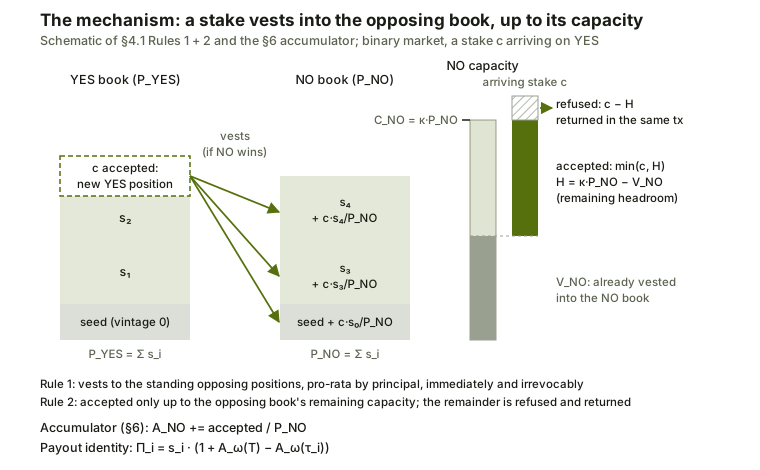
Rule 1 alone is unsound. With no cap on what a book may absorb, the first position on an empty book receives all opposing inflow until a second joins, so return on capital diverges as the position shrinks: a seeding straddle returned +155% at $50 a leg and +82,037% at one cent a leg in the design phase, and the shipped suite pins a 200,001× single-probe divergence (P5). The profit-maximizing strategy would be to post dust on every new market and toll the flow. Rule 2 is what makes Rule 1 a mechanism rather than a toll booth, and its placement matters: capacity constrains acceptance at the book level, never the distribution, which stays pure pro-rata. Pro-rata makes return on capital scale-invariant, so dust earns exactly the multiple any capital entering at that moment earns, and the acceptance cap bounds that common multiple by 1 + κ(1 + ln g), g the book's subsequent principal growth (P5). Keeping the distribution uncapped is also what keeps §6's constant-time form exact (Appendix A.4). Rule 2 is what a betting exchange already does: a matching constraint with the partial fill as its familiar consequence.
4.2 A worked example
Binary market, κ = 9, fees zero, λ = 1. The creator seeds $25 on each outcome in a reserved vintage 0 whose legs match each other. Five ordinary stakes follow. This log ships as the first pair of conformance vectors, so every number below is machine-checked.
| # | time | who | outcome | stake |
|---|---|---|---|---|
| 0 | 0 | creator | YES / NO | $25 / $25 |
| 1 | 10 | A | YES | $100 |
| 2 | 30 | B | NO | $200 |
| 3 | 60 | C | YES | $300 |
| 4 | 90 | D | NO | $200 |
| 5 | 99 | E | YES | $200 |
Accepted pool $1,050. If YES realizes (classic pays every YES holder a flat 1.680×):
| position | staked | vested | payout | multiple | classic |
|---|---|---|---|---|---|
| creator (YES leg) | $25 | $76.76 | $101.76 | 4.070× | 1.680× |
| A (t=10) | $100 | $207.06 | $307.06 | 3.071× | 1.680× |
| C (t=60) | $300 | $141.18 | $441.18 | 1.471× | 1.680× |
| E (t=99) | $200 | $0 | $200.00 | 1.000× | 1.680× |
If NO realizes (classic pays a flat 2.471×):
| position | staked | vested | payout | multiple | classic |
|---|---|---|---|---|---|
| creator (NO leg) | $25 | $170.09 | $195.09 | 7.804× | 2.471× |
| B (t=30) | $200 | $360.79 | $560.79 | 2.804× | 2.471× |
| D (t=90) | $200 | $94.12 | $294.12 | 1.471× | 2.471× |
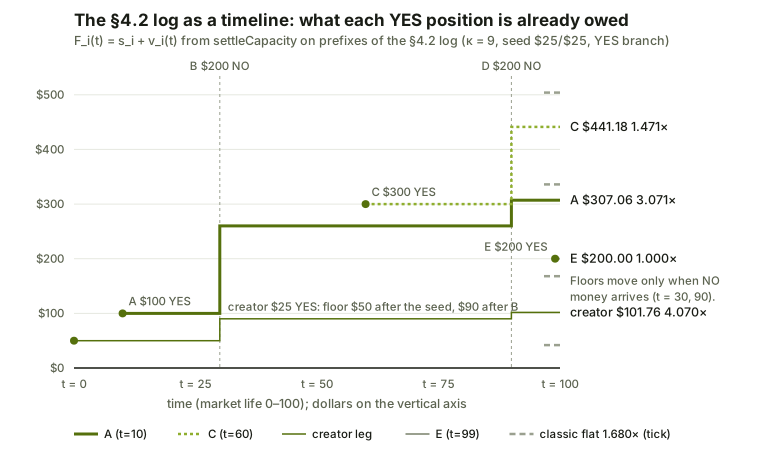
Six things to read off the tables. Payouts total $1,050 exactly in both branches. The classic column is flat: 1.680× to A, who carried the risk for 89% of the market's life, and 1.680× to E, who arrived after the last opposing dollar; the vested column pays 3.071× and 1.000× out of the same pool. E is paid exactly its principal, whereas under classic rules E takes $136 of profit, every cent from A, C and the creator. The creator staked $50 across both legs and recovers $101.76 or $195.09, because at vintage 0 the legs are each other's counterparty. A's claim of $207.06 was accrued before E arrived and E's arrival does not touch it; under classic rules A's multiple falls from 2.000× to 1.680× when E enters. C is not punished for being third: it simply shares only the flow that arrives after it.
4.3 Capacity, and why the bounty is gone
The obvious alternative is to hold unmatchable flow in a bucket and meter it to later entrants at a decaying bonus. Appendix A.2 shows why it fails. Rule 2 needs none of it: no bucket, no schedule, no residual refund. In their place is one published constant κ, a maximum-odds cap, the object every betting exchange already publishes. Acceptance headroom on a book is C_w − V_w; with stakes assigned in full to every opposing branch this is the test (κ+1)·P_w > Π, computed from two running scalars.
In a binary market the favoured side receives partial fills once the underdog book is saturated. That is a liquidity signal, and it is not free to weaponize for a trader who does not want the position: exhausting the headroom a rival needs means staking their side yourself, at full risk (conformance case P10). For a trader who wants the exposure anyway the block is free at the margin (P10b), and seizing the remaining headroom converts shared future vesting into an exclusive claim. Under a binding κ, entry is a race for headroom between same-side traders; the block-vintage rationing of §4.4 removes the within-block race, and per-account caps are the venue-level mitigation for the rest.
In an n-way market the constraint couples across branches. Acceptance takes the minimum headroom over every opposing book, so the thinnest book gates entry on every outcome opposing it. A three-outcome market with one unloved branch refuses 97.5% of gross volume at κ = 9 (case P9b), and a $450 stake on a side outcome blocked a $2,000 informed entry entirely (P9). Worse, for n ≥ 3 the degraded state is absorbing, with a closed-form trigger (P9c): a symmetric seed S leaves every book exactly S(κ − n + 1) of headroom, one stake of that size on a single outcome consumes the headroom of the n − 1 books opposing it, and thereafter every outcome has a saturated book among its opponents, so no entry on any outcome at any size is ever accepted again. Capacity grows only with principal and principal can no longer grow. At κ = 9, n = 3 and a $50 seed the trigger is $350; it is reachable at any point in a market's life; n = 2 alone self-heals. On the real tape of §13.4, at κ = 9, 51 of 429 n-way markets froze this way and 22.7% of their gross was refused.
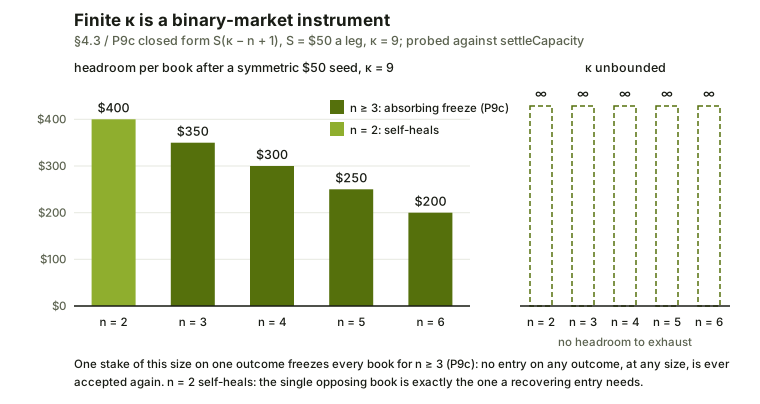
The rule for venues: finite κ is a binary-market instrument. Markets with three or more outcomes should run κ unbounded. The mechanism's soundness does not depend on the cap; what holds it up without κ is the mandatory all-outcome seed (no empty book can exist) and pro-rata scale-invariance (dust earns what same-moment capital earns). What unbounded κ does give up is stated in §4.6: with no headroom to exhaust, a dust seed passes the creation rule and accepts an entry of any size against it (case P12), which is Appendix A.1's toll reintroduced, so a venue running κ unbounded must publish a minimum seed per leg.
4.4 Creation, entry, exit
Creation. A market opens when its creator posts a seed on every outcome in a reserved vintage 0 that no other entry may share. The legs are counterparties to one another, which floors the seed (P6) and makes the floor robust: there is no one to interpose. The seed obeys Rule 2 among its own legs. Because each leg's capacity comes only from the other legs, vintage-0 acceptance is a joint condition, computed in integer units as the fixed point of
a_o ← min( offered_o , ⌊ κ · min_{w≠o} a_w ⌋ ) iterated until no leg changesThe map is monotone non-increasing and bounded below by zero, so it converges; every symmetric seed at κ ≥ 1 is a fixed point after one pass, and for n = 2 the closed form is a_Y = min(offered_Y, ⌊κ·a_N⌋), a_N = min(offered_N, ⌊κ·a_Y⌋). An asymmetric seed is partially refused rather than allowed to violate the leverage bound; κ ≥ 1 is a domain requirement, below which no symmetric seed passes. A seed that leaves any outcome unbacked, including by integer allocation flooring a dust leg to zero, voids the market at creation (P11). This creation rule, not Rule 2 alone, guarantees every book is non-empty for the life of the market, and P1's proof leans on it.
Entry. All entries in one block share a vintage, and the batching rule is normative. (i) Every entry in a vintage vests to the books as they stood at the start of the vintage, so same-vintage entries never vest to each other. (ii) Capacity granted by a vintage's entries becomes usable only from the next vintage. (iii) When the joint same-vintage demand D_w against an opposing book, summed over offered amounts, exceeds its headroom H_w, every entry opposing w is capped at ⌊c_e·H_w/D_w⌋, and an entry's accepted amount is the minimum of its caps over the books it opposes. The rationing is a single pass. Headroom left unused on one book because an entry was cut by another book is not re-offered within the vintage (case R1 pins a log where a redistributing implementation returns a different acceptance). With (i) to (iii), settlement is invariant under permutation within a vintage in both vesting and acceptance (cases V1 to V3), so there is no intra-block ordering game. Order-free is not size-strategyproof: an entry's rationed share rises with its offered size while the refused remainder costs nothing, the standard property of pro-rata matching. A venue can fee or bond the offered amount, cap per-account offers, or run κ large. Inter-block priority is a limitation, not a solved problem (§14).
Exit. Positions are transferable; a transfer moves principal, vested claims and vintage intact and is invisible to settlement. A position may be split or merged within its vintage class. Split and merge are settlement-invariant in exact arithmetic by linearity; in integer arithmetic they perturb settlement only through allocation rounding, at most one unit per later opposing event per piece (case X1), and under a binding κ the pieces may lose one unit between them to the rationing floor, which propagates as up to κ units of capacity. Positions in the same vintage class are fungible under §6 because they share an accumulator snapshot.
Fees. The fee base is venue policy. The reference convention charges the fee on the accepted stake at entry; the refused remainder of a partial fill is always returned gross.
4.5 The λ family
Vest a fraction λ of each stake by Rule 1 and settle the remaining 1−λ as a classic terminal pool. The composition with Rule 2 is specification: acceptance, capacity, and the seed clamp operate on the full stake exactly as at λ = 1; only the settlement of the accepted amount splits. Because vesting is linear, a winner's blended payout is a closed form from one λ = 1 settlement,
Π_i(λ) = λ·(s_i + v_i) + (1−λ)·s_i·M M = the classic multiple of the accepted poolλ = 0 is the classic parimutuel up to Rule 2's refusal; λ = 1 is the pure mechanism. λ is a dial on a trilemma:
| no-lock corollary (P4) | creation floor (P6) | dilution protection | late hedging | |
|---|---|---|---|---|
| λ = 1 | exact: buzzer entry pays 1× | unconditional | maximal | none |
| interior λ | void: a buzzer snipe pays λ + (1−λ)·M | void (λ = 0.5: seed min −16.8% simulated, −24.0% on the real tape) | ≈ (1−λ) of classic dilution on average | partial |
| λ = 0 | void | void | none | full (classic) |
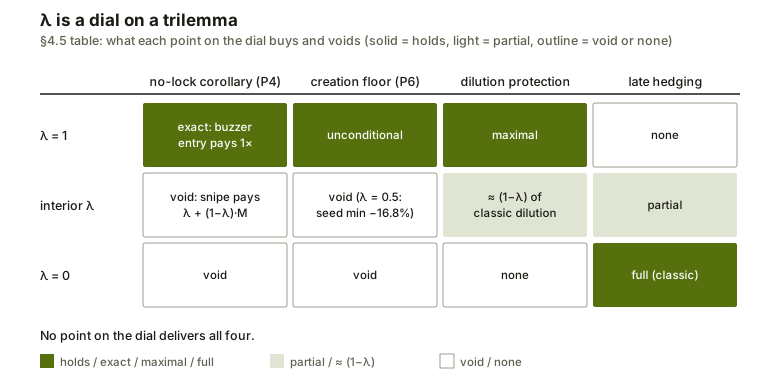
No point delivers all four; a venue chooses per market class. A market run at interior λ for hedgers has given up the creation floor, so the seeding story of §10 does not apply to it, and its lock-window incentive is back in proportion to 1−λ. Degradation is monotone but not uniform: the late entrant's reward is exactly linear in λ (P7), while the mean dilution measured in §13 sits below the linear reading at every interior λ.
4.6 Normative summary
An implementation conforms to this specification when it satisfies every item below. MUST items are the mechanism; POLICY items are parameters a venue publishes before a market opens, like a fee table.
- MUST implement Rule 1 and Rule 2 as stated in §4.1, with stakes assigned in full in every opposing branch.
- MUST open a market only on an all-outcome seed in a reserved vintage 0, clamped by the integer fixed point of §4.4, and void creation if any leg is zero after integer allocation (P11). κ ≥ 1.
- MUST batch entries by block into vintages and apply (i) vintage-start books, (ii) next-vintage capacity, (iii) single-pass pro-rata rationing on offered amounts with no redistribution.
- MUST settle each winning position as
s_i·(1 + A_ω(T) − A_ω(τ_i))from the accumulator of §6, in integer units, with a deterministic allocation rule, never overpaying the accepted pool, and assign the residue to the residue owner fixed at creation. - MUST fix the resolution timestamp at creation, freeze the accumulator there, and refuse every entry at or after it in full (§12, case F1). Event-driven markets freeze at the earliest of the outside date and the first bonded attestation.
- MUST refund every non-seed position at accepted principal in the void branch (case V4).
- MUST, on-chain: use a transfer-exact settlement asset or measured balance deltas; make payouts, refunds and the residue pull-based; complete all state updates before any external transfer; return the refused remainder of a partial fill no later than the close of its vintage, as a withdrawable claim; isolate per-stake failure in batched paths.
- MUST compose λ as in §4.5: acceptance at full stake, settlement split.
- SHOULD treat transfer, split and merge as in §4.4 and expose position state as the four numbers of §6.
- POLICY, published per market before it opens: κ (finite only for n = 2), λ, the fee and its base, the minimum stake unit, the residue owner, and the minimum seed per leg (mandatory where κ is unbounded, case P12).
An implementation claims conformance by passing the property suite and the 118 published vectors (§5.2) and stating the suite version and vectors hash it passed.
5. Properties
Stated for λ = 1 unless noted. Every hypothesis is load-bearing; Appendix A shows what breaks when one is dropped.
P1. Conservation. For every log, outcome and λ, payouts sum to the accepted pool exactly, in integer units. Proof. Fix ω and follow the contingent-ω ledger. Every accepted unit is placed at arrival into exactly one of: the principal of a position on ω, or the vested claims of a position on ω. Nothing decrements either. This is a bijection between accepted units and payout units. What guarantees a unit can always be placed is that every opposing book is non-empty: vintage 0 seeds every outcome, a seed that fails to voids the market, and at finite κ Rule 2 refuses any stake an opposing book cannot cover. ∎ Pinned on every vector, per branch, in integer units, and on all 5,173 real markets of §13.4.
P2. Monotone win-branch floor. F_i(t) = s_i + v_i(t) is non-decreasing and equals the payout if o_i wins. Proof. v_i is a sum of non-negative increments. ∎ The floor is conditional on the outcome realizing; if it does not, the position pays zero, and every use of "floor" in this paper is conditional in that sense.
P3. Accrued claims are invariant. Appending any stake to the log leaves every previously accrued v_i unchanged. Proof. Rule 1 writes only additively into the books as they stood at the arriving stake's vintage and never revisits an allocation. ∎ A later same-side entrant cannot touch what you have accrued, but it shares the flow you go on to accrue: under a 50%-of-pool late snipe, early winners' total payout falls 0.19% on average in simulation (4.9% worst) against 13.6% average and 64.4% worst under classic rules; on the real tape the median is 0.00% against 38.7% classic (§13.4).
P4. Late-entry neutrality. A stake accepted after the last opposing inflow is paid exactly its principal; for a trader with belief p < 1, its expected value is −(1−p)s < 0. Proof. No further increments arrive under Rule 1; apply P2. Under Rule 2 there is no unmatched residue to recover. ∎ Corollary: no lock window. The buzzer snipe that forces venues to close entry early pays 1× here, so markets can accept entries until resolution. §13.1 gives the unconditional number in simulation (snipe EV −1.05% here, +25.3% classic) and §13.4 gives it on real entrants (median 1.00× here, 1.49× classic).
P5. Linearity, scale-invariance, bounded leverage. Vesting is linear in principal, so splitting a stake across wallets at one vintage changes nothing, and every position on a book earns the same accumulator increment per unit of principal. Because acceptance is capped at the book level, that common multiple is bounded. Lemma. While a book's principal is P, accepted opposing inflow cannot exceed its remaining capacity κP − V; each new unit of same-side principal adds at most κ more, priced at the enlarged book. Integrating from entry principal P_τ to final P_T, a winner's multiple is at most 1 + κ·(1 + ln(P_T/P_τ)). ∎ Verified over 14,520 positions in adversarial random markets; an ε-position probing a seeded market returns 9.0× to 9.7× at κ = 9 across stakes of 1 to 10,000 units, against 200,001× under Rule 1 alone. This is not sybil resistance, and wash trading has a cost with a shape. A trader staking x on each side into books owned by strangers loses 50% in both branches when the legs share a vintage (case P5w). But the donation scales with (1−f), f the washer's share of the opposing book: for a participant who dominates both books the mechanism-level cost of printed volume falls toward zero, which is why §12 requires trust metrics that exclude self-vested flow.
P6. Creation floor. A creator who seeds every outcome in the reserved vintage 0 recovers at least the total seeded, in every branch and under every continuation. Proof. Immediately after the seed the creator owns every position; by P1 every branch pays the whole accepted pool to its owner; by P3 later flow only adds. ∎ Verified over 8,910 simulated branches and 5,173 real markets with zero violations; asymmetric seeds inherit the floor through the clamp. An implementation that admits any third party into vintage 0 breaks the floor in half of all branches (Appendix A.3).
P7. Blend degradation. At blend λ a late entrant's multiple is exactly λ + (1−λ)·M. Per-position dilution is signed: D_i(λ) ⋚ (1−λ)·D_i(classic) according as the position's pure multiple lies above or below M. In aggregate, the payout-weighted dilution of the pre-existing winning book under a buzzer entry is exactly (1−λ) times its classic value (case P7c), while the principal-weighted mean of per-position dilutions exceeds that line by Jensen's inequality (P7c'); the suite pins a log where an early position exceeds the naive per-position bound (P7a, P7b).
5.1 What the mechanism does not guarantee
- The floor is conditional on your outcome realizing. It is not downside protection.
- Late pool entry is supposed to die; the pool's late forecast measurably degrades (§13.2, §14).
- There is no equilibrium theorem (§9, Appendix B).
- Large early capital compresses everyone else's return (§9).
- λ < 1 voids P6 and re-opens the lock-window incentive in proportion to
1−λ. - κ, λ, the fee base, the minimum stake, the minimum seed and the residue owner are policy, not identities.
- The mechanism says nothing about resolution; §12 names the two attacks it makes sharper than a classic pool's.
5.2 Conformance cases beyond P1-P7
The suite pins more than the properties. P8: the O(1) accumulator settles identically to the reference in rational arithmetic and within one unit per opposing event in integer arithmetic. P9, P9b, P9c: n-way coupling, the skewed-book refusal, and the absorbing freeze with its S(κ−n+1) trigger. P10, P10b: the binary squat in both branches. P11: seed validity. P12 (new): the dust seed at unbounded κ. V1–V4: vintage semantics and the void refund. P7a–P7c': the λ family. P5w, A4, P1'/P6': wash costs, the per-position-cap breakage, asymmetric-seed conservation and floor. R1 (new): single-pass rationing. SC1 (new): the integer seed clamp. X1/X2 (new): split and merge. F1 (new): the freeze.
The conformance rule is exact on voided and on every accepted[i]; each winning payout may differ from the vector by at most one unit per later opposing accepted event plus one at claim (the P8 bound), and the sum of payouts may never exceed the accepted pool. Suite 1.2.0 ships 118 vectors, sha256 prefix ea5a52d3bbcb. The first edition's ±1-per-position rule was not attainable by a floor-division accumulator on 36 of its own vectors; the reference contract of §6 found that, and the rule is now the one the arithmetic supports.
6. Settlement in Constant Time
Rule 1 reads as a loop over every opposing position on every stake: O(m²) per market. On-chain that is fatal. The rule does not need the loop. It is linear in principal, so it collapses to a reward-per-share accumulator. Maintain per outcome the principal P_w and one scalar A_w. On an accepted stake of c on o:
for each w ≠ o:   A_w += c / P_w          (O(1))
record position:  (o, s, A_o at entry, vintage)
P_o += c
At resolution, position i on the realized outcome is paid Π_i = s_i · (1 + A_ω(T) − A_ω(τ_i)), which telescopes to the sum in §4.1. Block vintages batch cleanly: snapshot each A_w and P_w at the vintage start, accept and record every entry against the snapshot with §4.4's rationing, then apply the summed increments. Rule 2 costs nothing: acceptance is min over w ≠ o of (C_w − V_w) with two more running scalars per outcome. The entire mechanism is O(1) per outcome per entry and O(1) per claim, and a position's complete transferable state is four numbers. This is the sharp form of R6: each position's payout is a function of two scalars, its outcome's accumulator at entry and at resolution, so no participant's payout depends on any other participant's record.
Verified: the accumulator and the naive reference agree exactly in rational arithmetic across 26,458 positions in 800 random markets, including settlements where the cap binds and vintages ration (case P8).
On-chain arithmetic. With fixed-point floor division the identity becomes an inequality that never breaks in the dangerous direction: payouts plus refused stake plus a residue equal the pool, residue ≥ 0. Across 27,150 settlements at scales 10¹², 10¹⁸ and 10²⁷ the accepted pool was never overpaid. The residue bound is W + Σ_i s_i·m_i / S, with W the number of winners, m_i the opposing events after position i, and S the fixed-point scale. The "one unit per winner" reading holds when max s_i·m_i ≪ S; choose S ≳ s_max·m_max (S = 10¹⁸ holds it for 6-decimal stablecoins to roughly 10⁹-unit positions), or store the accumulator as a rational. The residue is a single computable claim and must have a named owner.
Reference contract and measured gas. This edition ships VestedParimutuel.sol (Solidity 0.8.28, no dependencies, MIT) with a differential test that replays all 118 vectors on the EVM, and NaiveVestedParimutuel.sol, the loop form, for measurement only. Gas is gasleft() around one external call with storage cooled, excluding the 21k base, at κ = 9 with a symmetric seed:
| operation | n = 2 | n = 3 | n = 5 |
|---|---|---|---|
| create (vintage 0, seed clamp) | 639,707 | 754,685 | 1,125,503 |
| entry opening a vintage, nothing to finalize | 169,548 | 192,022 | 236,967 |
| entry opening a new block, finalizing the previous vintage | 212,890 | 246,780 | 314,559 |
| entry joining the open vintage | 129,628 | 132,201 | 137,346 |
| entry refused by the freeze (revert) | 12,660 | ||
| resolve | 87,571 | ||
| claim, winning position | 62,473 | ||
| claim residue | 35,501 |
| vintage finalization, by entries buffered (n = 2) | 1 | 10 | 100 |
|---|---|---|---|
| gas | 81,413 | 388,176 | 3,452,045 |
| naive loop form, one entry against a book of B positions (n = 2) | B = 10 | B = 100 | B = 1,000 |
|---|---|---|---|
| gas | 161,213 | 649,463 | 5,532,036 |
The loop costs about 5.4k gas per opposing position touched, so a ten-thousand-position book is roughly 55M gas per entry, above any block's budget; the accumulator is flat at 130k to 315k. Two consequences of §4.4(iii) surface in the contract and are now specification. Because no transaction can know it is the last in its block, a vintage's acceptance is computed when the next block's first transaction finalizes it, so the refused remainder of a partial fill is a withdrawable claim from vintage close, not a same-transaction refund (§4.6 item 7). And the first edition's ±1 conformance tolerance was unattainable by floor division, which is why the rule is now the P8 bound (§5.2).
7. The Vesting Yield
A stake s on side o accrues the path integral V = s·∫ dΠ_opp / P_o. When the pool's composition q (your side's share) is constant over the interval, this closes to
V = s · ((1−q)/q) · ln(Π_T / Π_t)Write L = ln(Π_T/Π_t) for the pool's remaining log growth and y = ((1−q)/q)·L for the vesting yield. Break-even is p(1+y) = 1:
An entry is profitable iff
p/(1−p) > [q/(1−q)] / L.
Verified: the published script holds composition constant and measures pure discretization error, 0.005% to 0.02% at 10,000 steps, converging as O(1/steps).
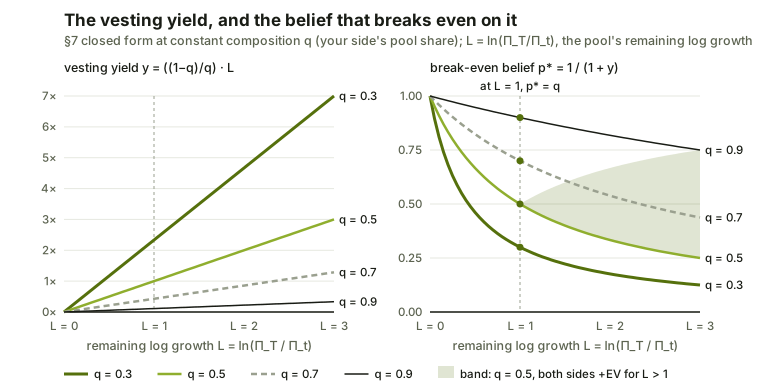
Entry-time price integrity. Under the classic rule, break-even is p > q_T: you are priced at the closing ratio, unknowable when you act. Here you are priced at the ratio prevailing when you enter, discounted by remaining growth. L = 1 is the natural scale: if the pool will grow e-fold after you, the condition collapses to p > q, textbook aggregation behaviour. L > 1 opens a two-sided band: both sides are simultaneously positive-EV whenever p/(1−p) lies in ((q/(1−q))/L, L·(q/(1−q))). Early in a fast-growing market the two implied prices do not sum to one. The primary pool ratio is therefore not a probability. It is a pool composition. §8 is where a probability comes from.
7.1 What the formula does not price
Composition drift. When q moves after entry the yield is the path integral, not the closed form. In our crowd the closed form is roughly unbiased in aggregate (mean signed error −0.03) but poor pointwise: the median absolute gap is 55% of the prediction, with a mass point at 100% from positions whose side receives no further opposing flow. An agent's edge in using the formula is exactly as good as its flow forecast.
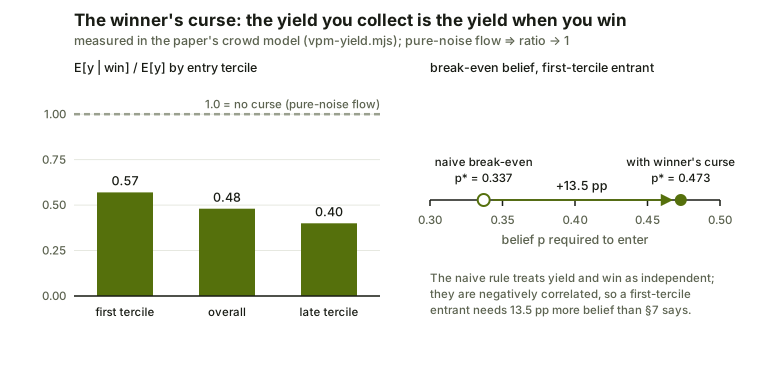
The winner's curse. The break-even treats the yield and the win event as independent. They are negatively correlated by construction: vesting comes from opposing inflow, opposing inflow is disproportionately informed, and informed opposing flow concentrates in the histories where your side loses. The decision-relevant quantity is E[y | win], and in our crowd model it is roughly half the unconditional yield: 0.48 overall, 0.57 for first-tercile entries, 0.40 late. For a first-tercile entrant the naive break-even belief of 0.337 corrects to 0.473. The correction vanishes for pure-noise flow, and §10's operators should treat it as a floor on required edge.
8. The Separation Principle
The primary layer settles. No payout depends on the final pool ratio, so end-of-life manipulation of that ratio has nothing to grab. Manipulating the displayed ratio late is strictly more expensive here than in a classic pool or a book, because the manipulator's stake earns nothing even when it is correct.
The secondary layer prices. A position is four numbers, so it trades cleanly. An informed trader late in a market does not inject into the pool, since P4 makes that pointless, but buys positions from holders, which reroutes late information through prices paid to risk-bearers.
The position-value identity. With A_o the accumulator, a position (o, s, A_o(τ), ν) at time t, under belief p̂ and expected remaining accumulator growth E[ΔA_o], is worth
value(t) = p̂ · s · ( 1 + A_o(t) − A_o(τ) + E[ΔA_o] )The first two terms inside the bracket are the floor tranche, a digital option with a payout known at t; the last is the flow tranche, the §7 yield forward, and its expectation carries the winner's-curse correction of §7.1. A dealer's fair bid is this value less a spread that prices adverse selection on p̂ and on E[ΔA_o] separately, which is why the two tranches trade differently (§11). Every input is recomputable from the public log; only p̂ and E[ΔA_o] are the dealer's own.
How strong this is. There is no guaranteed source of uninformed selling late in a market, and a standing cash-out vault is a designated adverse-selection sink. But the layer's capacity to carry the late forecast is a measured bound: §13.2 adds a stylized dealer to the crowd study, and the composite forecast's final-phase Brier is 0.054 to 0.057 at every spread from 2% to 20%, against 0.174 for the pool ratio and 0.148 for an unlocked classic pool. The model is generous (no inventory risk, no quote withdrawal), so read it as an upper bound on the layer and a demonstration that the late information exists. For short recurring markets no position market forms inside the round, and §15 specifies the venue-side RFQ cash-out as the degenerate secondary layer there.
9. Incentives
For a stake s with belief p, EV = p·y·s − (1−p)·s, with y from §7 and the §7.1 corrections applied.
Flow exposure. Any mechanism paying counterparty-liquidity rewards funds them from flow that has not arrived; that dependence is a property of the problem. Here it lives in the second term of the payout, where an agent can model it.
Timing. For a trader committed to a side and a size, entering earlier captures every intervening allocation. That is close to tautological. It is not a claim that waiting is irrational: waiting buys information, and a trader with impact facing a concave V(s) will generally split and delay. A metering whale also shapes the public q-path everyone conditions on. The unconditional timing problem is open (Appendix B).
Crowding out. Vesting is pro-rata by principal, so a large first vintage absorbs most future flow. Growing the seed from $50 to $5,000 a leg in simulation compresses ordinary early winners from 1.70× to 1.09× while the seeder sits at its floor; on the real tape, growing the seed tenfold takes first-third winners from 8.47× to 5.30× to 2.89× (§13.4). Small seeds are therefore the correct policy, not merely the cheap one. A venue whose creators seed heavily will look like a market-maker venue with floors: permissionless, floored, earning no information rent, but not the time-priced ideal. That is the mechanism's most likely real-world drift, and in that regime a book-dominant party can print wash volume at near-zero mechanism cost (P5), so headline volume stops being evidence of anything.
The reserved vintage. Vintage 0 cannot be competed for within a market, which is what makes P6 a theorem, so the creation floor is a rent the mechanism grants. Appendix B.3 states the tension: a contested seeding race and an unconditional floor are mutually exclusive, and this design picks the floor, because the seed doubles as the resolution bond (§12), because a floored position is what makes seeding the long tail a computable business (§10), and because competition moves across markets rather than disappearing. In our crowd model the reserved seed settles positive in 100% of 40,000 markets, and on the real tape in 5,173 of 5,173; a rational creator population will treat that as a subsidy schedule.
Time-priority ordering. A position's return above principal is funded exclusively by subsequent opposing stakes: event-contingent counterparties who, in the other branch, collect the position's principal. Later same-side entrants fund earlier ones with nothing: their accrued claims are untouchable (P3) and the last same-side cohort is paid exactly its principal (P4). Nobody's payout improves by recruiting anyone. The honest analogy is a bookmaker's book that pays its counterparties by arrival time.
10. Agents
R7 asked who arrives first at the ten-thousandth market. Seeding is a legible job: a creation floor, closed-form position value, and economics that depend on forecastable quantities rather than on out-quoting a professional. Machine-payable rails make the marginal cost of reaching a new market near zero; the cost of seeding it is the opportunity cost of floored capital plus resolution risk.
Three limits. Competition for vintage 0 is a conjecture about behaviour. Whether the race clears at agent speed is empirical. And the entry rule's profitability is exactly as good as its flow forecast, with teeth: in the sparse long-tail regime (§13.2, roughly 27 stakes a market), agents using the naive growth estimate L̂ = ln(T/t) realize −11.5% per entry post-fee while the same beliefs under classic rules earn +11.2%. Operators should form L̂ from realized per-class growth curves, never from promotional volume.
11. Positions as Primitives
A position is a deterministic transferable claim with a monotone win-branch floor. It maps onto semi-fungible tokens, one class per market × outcome × vintage, and same-vintage positions are fungible because they share an accumulator snapshot. Its value splits into the floor tranche and the flow tranche of §8, letting a holder keep conviction and sell activity, or the reverse. The pricing inputs require no new trust; the instruments do: tokenization adds contract risk, collateralization adds dependence on whatever marks the position, and the flow tranche adds counterparty risk on an unsettled claim. This section describes what is representable; it is not a proposal to offer instruments.
12. Resolution
We propose nothing new mechanically: staked resolution bonds with slashing, escalation games, and dispute juries are the deployed designs of Augur, UMA and Kleros. What this section asks of a venue is operational: every creator carries a public history surfaced via API so agents can price resolution risk; unresolved markets auto-refund; a winning outcome with no backers voids. Because P5 shows a book-dominant party can print volume, track-record metrics must exclude self-vested flow and weight bonded, aged, distinct counterparties.
The mechanism changes the resolver's incentives in three specific ways, two for the worse.
Delay farming. Accrued claims are monotone, so a resolver holding a winning position has an incentive to delay: every extra dollar of opposing flow vests to them at no risk. The fix is mechanical and is now normative (§4.6 item 5): fix the resolution timestamp at creation, freeze the accumulator there, and refuse every entry at or after it in full. Then latency has zero payoff impact. For event-driven markets the freeze triggers at the earliest of an outside date and the first bonded attestation, so the resolver can accelerate the freeze but never extend it; a defeated attestation un-freezes the market and slashes the bond.
Stall-into-void. A resolver on the losing side of a large vested payout has a strictly profitable strategy of never resolving: at the refund deadline they recover their losing principal and every counterparty's accrued claim evaporates, and because accrued claims are public, the staller knows exactly what silence saves them. Three rules close it. A timeout forfeits the resolver's seed to the dispute layer, so silence costs 2× seed and rises with escalation. Fallback resolution is permissionless, with a bonded void declaration through the same path so an honest creator of an unresolvable market can void without forfeiture. And in the void branch every non-seed position refunds at its accepted principal (case V4).
The direction premium. A creator-resolver holds the seed on every outcome, so whichever way they resolve they hold the winning leg, and the legs do not pay alike: the winning leg farms the losing flow, so the seed pays more in the branch with more opposing volume. The gap, seed·(A_w(T) − A_w'(T)), is a closed-form, publicly computable premium attached to resolving toward one side, steeper here than in a classic pool. Venues should display it live, score creators on resolution direction against the pool-implied favourite, and make vintage 0 slashable on adverse rulings. Since the bond is fixed at creation while what it secures grows, escalation bonds must scale with the disputed declared-branch payout, a quantity §6 makes O(1)-computable, which is a concrete advantage over classic pools.
13. Simulation and Replay
Three studies. §13.1 settles a fixed flow sequence under both rule sets, isolating settlement. §13.2 lets the crowd respond to the rules it faces, measuring participation and forecast quality. §13.4 replays a recorded tape from a live venue. Threats to validity are §13.3. Every number regenerates from the published scripts; the main study runs the actual mechanism (Rules 1 and 2, κ = 9, creator-seeded vintage 0) over 2,000 fifteen-minute binary markets per seed, 20 seeds, reported as mean ± 95% CI, with an informed-plus-noise crowd (75% noisy-informed, 25% noise; about 180 stakes of ~$10 median).
node docs/whitepaper/sim/vpm-study.mjs --markets 2000 --seeds 20    # §13.1: capacity rule, CIs, fees, κ sweep, n=3
node docs/whitepaper/sim/vpm-behavior.mjs [--sparse|--grid|--fixedpoint]   # §13.2
node docs/whitepaper/sim/vpm-yield.mjs                              # §7: discretization, drift, winner's curse
node docs/whitepaper/sim/vpm-estimators.mjs                         # §13.3: primary-layer late-price candidates
node docs/whitepaper/sim/vpm-tape-replay.mjs --seed 1000000         # §13.4: the real tape, both rules
node docs/whitepaper/sim/vpm-figures.mjs --markets 2000 --seeds 20  # figures 1–2 + the λ table
node docs/whitepaper/sim/vpm-figures-static.mjs                     # figures 3–11
node docs/whitepaper/sim/vpm-capacity.mjs                           # properties + cases (suite 1.2.0)
node docs/whitepaper/sim/vpm-accumulator.mjs                        # O(1) equivalence, residue bounds
node docs/whitepaper/sim/vpm-conformance.mjs                        # 118 vectors, settler-injection harness
13.1 The main study
Payout by entry time (median multiple on winning positions, by decile; mean of per-seed medians; every CI in the mechanism row is at most ±0.019):
| decile | 1st | 2nd | 3rd | 4th | 5th | 6th | 7th | 8th | 9th | 10th |
|---|---|---|---|---|---|---|---|---|---|---|
| classic | 1.40 | 1.37 | 1.36 | 1.36 | 1.36 | 1.37 | 1.38 | 1.39 | 1.40 | 1.42 |
| this mechanism, κ = 9 | 2.54 | 1.76 | 1.45 | 1.29 | 1.20 | 1.14 | 1.09 | 1.06 | 1.03 | 1.004 |
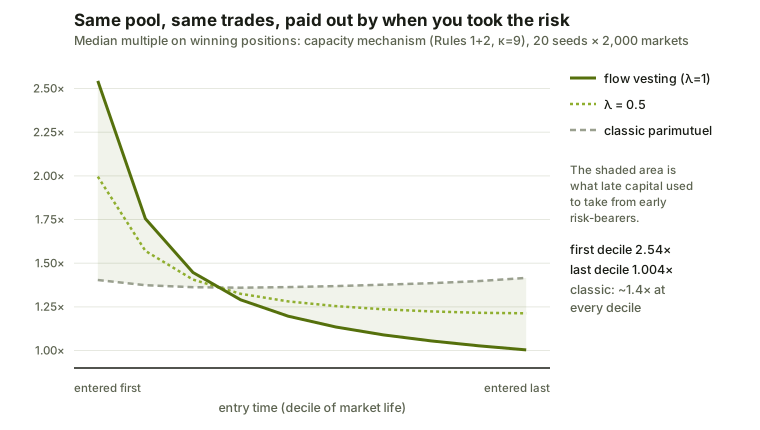
Last-decile entrants capture 13.20% ± 0.07 of the losing pool under classic rules and 0.28% here. Rule 2 refuses 0.10% ± 0.02 of gross stake at κ = 9 in this crowd; κ = 3 refuses 10.1% and κ ≥ 12 refuses nothing to two decimals. At n = 3 the pattern holds (refusal 1.03%, deciles 4.50 → 1.01), though §4.3's skewed-book case is not representative of it.
The buzzer snipe. The sniper stakes 50% of the gross pool on a >85% leader at t = 0.95T, inserted at its timestamp (Appendix A.5). Restricted to triggers where the leader wins, the sniper's multiple is 1.005 ± 0.00006 here (Rule 2 fills 97.7% of intended size) against 1.273 ± 0.003 classic, and early winners' payouts fall 0.19% on average (4.9% worst) against 13.64% average and 64.4% worst. Counting every trigger, the leader wins 98.42% of the time it qualifies, which makes the snipe's unconditional expected value −1.05% ± 0.13 pre-fee here (−3.03% post-fee), against +25.27% ± 0.33 pre-fee (+22.76% post-fee) under classic rules. That pair of signed numbers, not a lock rule, is what deletes the buzzer strategy.
Post-fee. At a 2% entry fee the last-decile multiple is 0.984. The creation floor survives fees: worst case across 40,000 settled markets, +8.6% after fees, because the floor already contains vested flow by the time fees matter; in a market with zero flow the seed returns break-even minus fees.
The λ dial (capacity mechanism at every λ, 20 seeds, sniper inserted by timestamp):
| λ | last-decile multiple | early-winner dilution (mean) | seed straddle mean / min / % positive |
|---|---|---|---|
| 0 | 1.416× | 13.5% | −18.0% / −44.4% / 16.6% |
| 0.25 | 1.315× | 9.0% | +27.7% / −30.6% / 70.8% |
| 0.5 | 1.213× | 5.5% | +73.4% / −16.8% / 97.0% |
| 0.75 | 1.112× | 2.6% | +119.0% / −3.0% / >99.9% |
| 1 | 1.004× | 0.2% | +164.7% / +10.9% / 100% |
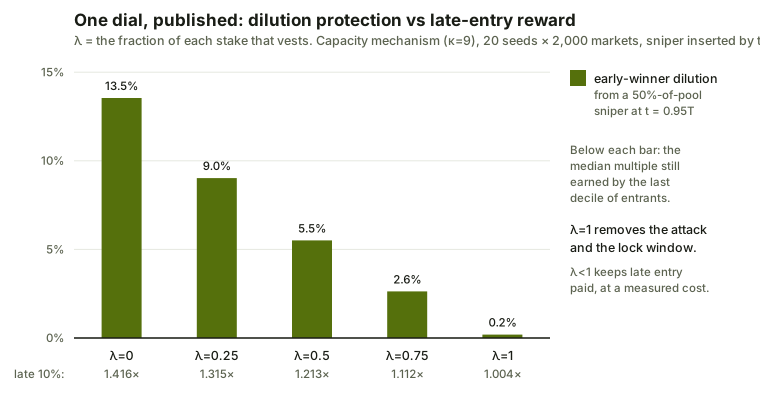
Seeding (creator seed, matched vintage 0, 20 seeds): worst case across 40,000 markets +10.9% pre-fee and +8.6% post-fee; zero of 40,000 negative (95% upper bound 0.0075%); mean +164.7% ± 1.3. The mean is a property of our crowd model; the floor is a property of the mechanism. This is payment for cold-start risk-bearing, concentrated in whoever bears it first. It is not a yield, and quoting it as an APY misquotes us.
13.2 What happens when the crowd responds
A second study lets each trader decide whether to enter under the mechanism they face, with entry rules in the same units across arms: under classic rules, enter the better side when its return EV clears fee plus edge; here, enter when p̂·(1+ŷ) > 1 + fee + edge with ŷ from §7 and L̂ = ln(T/t). A third arm is the deployed baseline, a classic pool with a lock at 0.95T, and a fourth repeats the mechanism with the conservative estimate L̂/2. Same belief stream, same arrivals, same sizes; 20 seeds × 2,000 markets, 2% fee.
Volume, share by phase of market life:
| arm | first third | middle third | 67–95% | final 5% | total $/market |
|---|---|---|---|---|---|
| classic (no lock) | 32.9% | 33.3% | 28.7% | 5.1% | 2,845 |
| classic + lock | 34.6% | 35.1% | 30.2% | 0.1% | 2,702 |
| this mechanism | 43.9% | 34.7% | 19.7% | 1.7% | 2,254 |
| conservative L̂/2 | 48.5% | 30.6% | 18.8% | 2.1% | 1,748 |
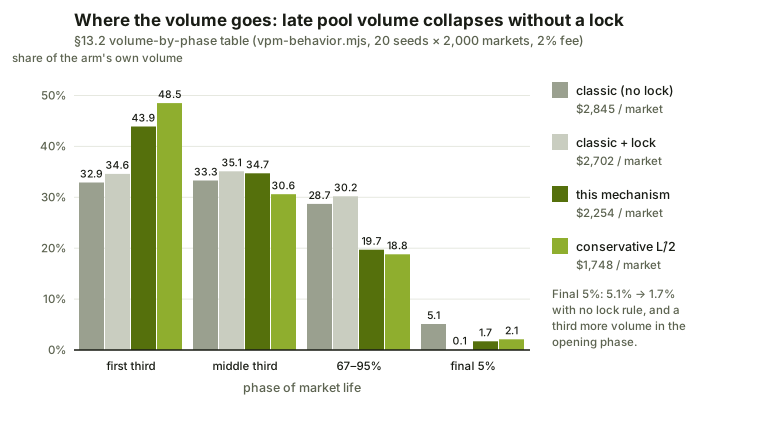
Late pool volume collapses (5.1% → 1.7%) without prohibiting anything, while a third more volume moves into the opening phase, at the cost of 21% less total volume. Forecast quality, Brier score of the pool ratio by phase (lower is better):
| arm | first third | middle | 67–95% | final 5% |
|---|---|---|---|---|
| classic | 0.239 | 0.202 | 0.168 | 0.148 |
| classic + lock | 0.239 | 0.202 | 0.168 | 0.150 |
| this mechanism | 0.239 | 0.201 | 0.171 | 0.174 |
| conservative L̂/2 | 0.240 | 0.197 | 0.183 | 0.180 |
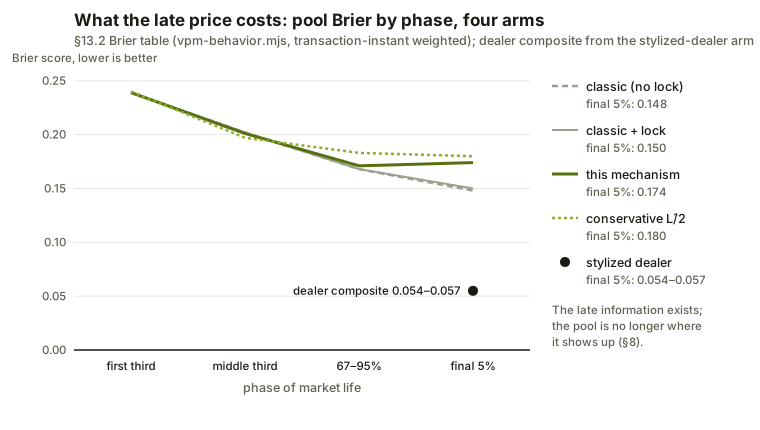
Three readings. The volume migration buys no measurable early forecast gain: within this crowd model, paying for time priority does not improve the price, it protects the payout, and this paper stops implying otherwise. The late-phase cost against the deployed baseline is 0.174 against 0.150. And a fixed-clock re-measurement (one snapshot per market at identical instants) agrees: 0.167 against 0.145 and 0.152.
Who gets paid. Realized per-entry PnL post-fee by trader type: informed +1.4% and noise −26.1% here, against +5.9% and −20.7% classic. Payment is information-blind conditional on the moment, exactly as P5 requires (an early noise winner's multiple, 2.22×, is slightly above an early informed winner's, 2.10×); the informed–noise differential arises through selection, and under the naive estimator the noise side's deeper losses accrue to the seed and to fees rather than to informed entrants. In the sparse arm the same naive rule goes to −11.5% while classic earns +11.2%.
The stylized dealer. Adding a layer in which each late informed arrival prints at its belief shaded by half a spread, the composite forecast's final-phase Brier is 0.054 to 0.057 for every spread from 2% to 20% (0.075 to 0.077 sparse). The late information exists; the pool is no longer where it shows up.
The growth estimate iterated to a fixed point. Replacing L̂ = ln(T/t) with the previous iteration's realized growth curve and repeating: the phase-volume profile converges in four iterations toward an interior point, not collapse. Volume contracts about 20%, the first-third share rises to 50.4%, informed PnL improves from +1.3% to +4.6%, and the final-phase Brier drifts from 0.176 to 0.184. Rational flow thins, arrives earlier, and stabilizes, in this crowd model. The theorem remains open (B.4).
Favorite-longshot calibration at 0.95T: the mechanism's displayed ratio is mildly compressed toward the seed's 50/50 prior relative to classic, a stale-price effect of rational late flow staying out; it is not a longshot-subsidy tilt in realized frequencies.
13.3 Threats to validity
- The secondary layer is bounded, not designed. The dealer arm shows a thin layer would carry the late forecast; it does not show who quotes it or at what adverse-selection cost (B.4).
- The cheaper repair does not exist. Three primary-layer estimators of the late price (recency-weighting, early-weighting, inverting the entry rule) were tested against the classic arm as control; none is competitive with the dealer's 0.054, and recency-weighting helps the classic arm more. §8 is load-bearing.
- Near-myopic agents. Entry rules are thresholds; the fixed-point mode is an equilibrium in the estimator only.
- One crowd model. The grid sweeps informed share and belief noise and the sparse arm covers thin markets, but arrival, sizing and the noise family are single choices. The floor rows and identity-based claims do not inherit them.
- Fifteen-minute binary markets. Carry (§14) is not simulated.
- The real tape (§13.4) fixes flow, not behaviour. It measures what the two rules pay the same people for the same trades; it cannot measure what the crowd would have done under the new rule, and its crowd is almost entirely trading agents deployed by the venue's participants.
13.4 The real tape
The tape is every resolved market with at least 20 trades on at least two outcomes from one live paper-money parimutuel tournament that ran the classic rule with no lock window and no seed, from 2026-07-08 to 2026-08-05: 5,291 markets, 779,549 trades, 458,957 wallet identifiers, of which 4,862 are binary (up/down rounds from five minutes to a month) and 429 have three to six outcomes (price and market-cap ladders, a three-way coin flip). It is published beside the suite as vpm-tape-v1.json.gz, anonymized (family and ordinal in place of the market slug, dense integer wallet ids, relative timestamps, stakes net of the venue fee). Because the entrants decided under classic incentives, the replay is the §13.1 design on real flow: settlement isolated, behaviour held fixed.
Conventions. The tournament had no seed, so a symmetric seed of 1,000,000 units per leg is inserted in vintage 0, about 1% of the median gross pool and five times the median stake, with a tenfold sweep either side. The tournament had no blocks, so entries sharing the same second form one vintage. Binary markets run at κ = 9 with a κ sweep; n-way markets at κ unbounded, with κ = 9 reported as the empirical P9c test. Entry time is measured on [0, T] with T the market's last trade. Real markets are far more skewed than the simulated crowd, so every cross-market statistic is the median across markets of the per-market statistic, with the mean shown where it changes the reading. 118 markets resolved to an outcome nobody traded and are excluded (with a mandatory seed, the seed's leg would hold that whole pool). Conservation held exactly in all 5,173 settled markets.
Payout by entry time, binary (median winning multiple by decile):
| decile | 1st | 2nd | 3rd | 4th | 5th | 6th | 7th | 8th | 9th | 10th |
|---|---|---|---|---|---|---|---|---|---|---|
| classic | 1.23 | 1.23 | 1.29 | 1.27 | 1.27 | 1.29 | 1.30 | 1.34 | 1.34 | 1.24 |
| this mechanism, κ = 9 | 2.72 | 2.18 | 1.89 | 1.73 | 1.55 | 1.43 | 1.32 | 1.23 | 1.15 | 1.00 |
and n-way, κ unbounded: classic flat at 4.8× to 5.6× across deciles; this mechanism 13.28 → 7.74 → 5.63 → 4.48 → 3.66 → 3.02 → 2.44 → 1.95 → 1.56 → 1.15.
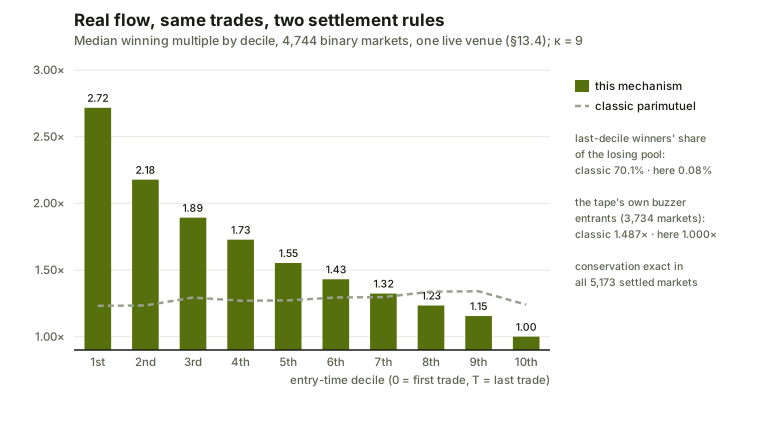
The free-ride in the wild. Under the classic rule, last-decile winners captured a median 70.1% of the losing pool (mean 57.1%); here 0.08% (mean 13.7%). The tape's own buzzer entrants, the last winning-side trade in the final 5% of a market's life in 3,734 markets, earned a median 1.487× classic (mean 5.77×) and exactly 1.000× here (mean 1.87×, the mean carrying the cases where losing flow still arrived after them). Everyone who entered in the final 5%, both sides, 136,015 positions: realized return median +1.9% classic (mean +43%), median −11.1% here (mean −33%). Early winners' payout without the final-5% winning-side entrants against with them: dilution median 38.7% classic (p99 96.6%), median 0.00% here (mean −1.8%, since late losing flow pays early winners; p99 71.6%, the tail where a late same-side whale precedes heavy late losing flow, which is P3's future-accrual caveat measured).
Rule 2 on real flow. This flow is bursty and one-sided in a way the simulated crowd is not, and the cap bites accordingly. At κ = 9 the binary markets refused a median 45.9% of gross (mean 43.2%); κ = 30 refused a median 0.0% (mean 12.9%); κ = 100 a mean 0.8%; κ unbounded nothing, at a first-decile multiple of 2.47× against 2.72× at κ = 9. The cap's protective value is the P5 bound, not refusal, and a venue whose flow looks like this should run κ at 30 or above even in binary markets, or seed larger. At κ = 9 on n-way markets, 51 of 429 froze absorbingly, exactly the P9c mechanism.
The seed. At 1,000,000 a leg the synthetic creator's return has median +248%, minimum +0.1%, and is negative in 0 of 5,173 markets; at κ = 9 on every market the minimum is +0.0%. The sweep: 100,000 a leg, minimum +0.6%, first-third winners' median multiple 8.47×; 1,000,000, +0.1%, 5.30×; 10,000,000, +0.0%, 2.89×. The crowding of §9, measured on real flow.
The λ family on the tape (median last-decile multiple / median seed return / seed minimum / markets with a negative seed):
| λ | last-decile multiple | seed median | seed min | seed negative |
|---|---|---|---|---|
| 0 | 1.357× | −30.3% | −82.7% | 3,246 of 5,173 |
| 0.25 | 1.279× | +40.5% | −44.4% | 1,711 |
| 0.5 | 1.193× | +111.9% | −24.0% | 1,164 |
| 0.75 | 1.112× | +178.7% | −11.1% | 569 |
| 1 | 1.000× | +248.4% | +0.1% | 0 |
A classic seed loses money in 63% of these markets. The floor lapses at every interior λ, as §4.5 says it must.
What the tape is not. The crowd is almost entirely trading agents that participants deployed against the venue's API (a median 100% of a market's trades come from wallets the venue registers as agents), it is concentrated (the top wallet holds a median 8.1% of a market's stake, and 63.7% at the 90th percentile), and its pool ratio forecast poorly (Brier 0.39 in the first third, 0.32 in the final phase, both rules, since flow is fixed). It is a real record of what parimutuel flow does when late entry is free and the entrants are machines, which is the population R7 and §10 expect to seed and trade the long tail; it is not evidence about human forecasters, and it says nothing about how these entrants would have behaved under the new rule. By family, the first-decile multiple divided by classic runs from 1.2× (hourly and 15-minute rounds) to 4.7× (market-cap ladders), and the last-decile ratio from 0.76 to 0.20: the longer and more skewed the market, the more the classic rule had been paying its last arrivals.
14. Limitations
Finite κ does not survive n-way markets (§4.3). Venues must run n-way markets at unbounded κ with a published minimum seed. The obvious repair, a matched all-outcome top-up obeying the vintage-0 rule, is stated as an open problem in B.5, because its interaction with P6 and P3 is unanalyzed.
Late-stage pool odds. Beyond §7's two-sided band, unrewarded late entry means the ratio stops tracking probability near resolution: final-phase Brier 0.174 against 0.150 under the deployed lock baseline. The information is recoverable off-pool (§8); building the venue that recovers it is the open design problem.
Inter-block MEV. Vintage determines payout, so a party who sees a stake before inclusion can take the opposing vintage one block earlier and capture c·f/(P+f) of contingent claim with a stake of f, trading that against (1−p)·f of event risk; the loss falls on the honest early holders who would have shared that flow. Under a binding κ the same foresight steals acceptance headroom. Mitigations compose, each with a cost: commit-reveal entry, threshold-encrypted mempools, and widening the vintage to a k-block epoch. A venue on a centralized sequencer should treat flow confidentiality as a mechanism parameter. We claim the narrow thing: no intra-block ordering game.
Hedging. A party with real exposure wanting protection late faces +0% on a win and −100% on a loss; in a book or an LMSR they buy at 0.93 and are covered. Hedging-relevant markets should run λ well below 1, at the price §4.5 states.
Carry. Capital is locked from entry to resolution. At 4% and six months the 2% hurdle is the same order as the observed late-tercile win-conditional yield (median 2.7%), and it applies to the seed. λ = 1 is a short-horizon mechanism.
Favorite-longshot bias. Since y ∝ (1−q)/q, the mechanism pays more per winning dollar for backing the minority side, and that payment is information-blind. The measured effect is compression of the displayed ratio toward the seed's prior, not a realized-frequency tilt; the displayed-price distortion |q − p| worsens in every phase (§13.2).
Cascades and manufactured growth. Entry is a strategic complement in expected growth: entry EV rises in L̂ and realized L rises in entry, so the same market can rationally clear as a frenzy or a ghost town on volume expectations alone. Agents must anchor L̂ on realized base rates, which P5 shows a book-dominant party can manufacture.
Venue handle. In the crowd model the rule costs 21% of volume (§13.2) and deletes the lock window. The paper cannot net those from simulation, because the volume the lock window forgoes is a property of a venue's own late flow. The real tape gives the venue-side arithmetic instead: with entry open to the last second, 70% of the losing pool went to last-decile entrants under the classic rule, so the choice for such a venue is between losing that late handle to a lock and paying it to early risk. A venue whose late flow is a small share of handle has little to gain from this rule and something to lose.
No equilibrium theorem. The unravelling worry is that if no rational flow arrives after some t*, L before t* is generated by noise alone, pushing the horizon earlier. Two things temper it: the horizon is side-dependent (the two sides' yields differ by ((1−q)/q)², 81-fold at q = 0.9), and abstention is self-limiting, since arriving information accumulates as a widening |p − q| edge. §13.2's fixed point is consistent with an interior. The theorem stays open (B.4).
Limits of verifiability. §6 removes pricing trust. It does not remove trust in the completeness and ordering of the trade log, in resolution, or in whether the venue applied its published policy parameters, which should be committed on-chain per market.
15. Deployment
Nothing here requires a particular venue, chain or frontend. The mechanism's risk structure dictates an order of adoption, least-recoverable risk last:
- Paper first. Flow-vesting settlement in a paper-money twin.
- The secondary layer where it can exist. For markets long enough for a position market to form, ship transferable positions and the cash-out affordance before real money.
- Real money where P4 bites, with the degenerate secondary layer built in. Short-duration recurring markets get λ = 1 plus a venue-side RFQ cash-out at a published spread. The vault's quote must never be a mechanical function of the current pool ratio, or the manipulation §8 disarms comes back through the vault at P5's near-zero printing cost; it must price from the venue's own model over wash-excluded flow.
- Creator-seeded permissionless creation, with the reserved vintage 0 as the first rung of the resolution bond and §12's rules in place from day one.
Choosing κ. κ is a maximum-odds cap. Its protective value is the P5 bound; its cost is refusal, which depends on how one-sided the venue's flow is.
| κ | multiple bound at g = 1 / g = 10 | refusal, simulated crowd | refusal, real tape (binary, median) |
|---|---|---|---|
| 3 | 4× / 10.9× | 10.1% | 82.8% |
| 9 | 10× / 30.7× | 0.10% | 45.9% |
| 30 | 31× / 100.1× | 0.00% | 0.0% (mean 12.9%) |
| 100 | 101× / 331.3× | 0.00% | 0.0% (mean 0.8%) |
| ∞ | unbounded | 0 | 0 |
Chain requirements. The settlement identity is one accumulator update per outcome. The one chain sensitivity is block time, which is the mechanism's time resolution: at two seconds the inter-block game of §14 is small; at twelve it is not. The rest are rails: a native stablecoin, per-transaction attribution, and a machine-payable request standard alongside agent-readable discovery.
16. Conclusion
Information has a value curve, worth the most when few hold it and nothing when everyone does. A market that pays a flat multiple to everyone who was right, whenever they arrived, is mismeasuring the thing it exists to price. The rule in this paper, that losing flow vests to the opposing book at the moment it arrives and is accepted only as far as that book can cover it, produces a payout schedule with the shape of that curve, as arithmetic rather than as a promise.
Two honesty notes. What the arithmetic guarantees is payment for early risk-bearing; it pays information only through the hypothesis that informed capital arrives before the crowd, and in simulation the payment shape moves volume earlier without making the early price measurably better. The measured case for the mechanism is the other column: exact dilution protection, a deleted lock window with the buzzer strategy at negative expected value in simulation and at exactly 1.00× on real entrants, a floored seeding job that settled negative in none of 5,173 real markets, and a late price that must, and demonstrably can, come from a layer above the pool. None of the novelty is the gradient itself; Pennock had the essential half in 2004. What this work adds is that entry-time pricing becomes an accounting identity, runs on-chain in constant time at measured gas, comes with what an entrant is priced at and what that price omits, a dial to the classic mechanism with its trilemma stated, a conformance suite, and the cases where it fails.
Prediction markets number in the low thousands because each one must be worth a market maker's attention or an operator's subsidy. A market settled by arithmetic and seeded by its own creator carries no such per-market cost. We do not know what the ceiling is. We know it stops being the number of market makers.
FAQ
Why would anyone bet late? Into the pool, they shouldn't; that is the design. On the real tape the last winning-side entrant earned exactly 1.00× (§13.4). Late information should enter through the secondary layer, where it pays risk-bearers instead of taking from them.
Doesn't that destroy the price signal? It moves it, at a measured cost: final-phase Brier 0.174 against the deployed lock baseline's 0.150. Pool ratios are informative early and stale late, and §7 shows they are not even a probability in fast-growing markets. If you need live late pool odds more than dilution protection, that is what λ < 1 is for.
Is this a Ponzi? No, structurally. Returns above principal are funded exclusively by opposing, event-contingent stakes, never by later members of your own side, whose entry cannot touch your claim (P3) and whose own worst case is exact principal back (P4). No return is promised; the marketing surface is a conditional floor; no participant's payout improves by recruiting anyone. What is true, and disclosed, is that early seeding returns depend on future two-sided flow arriving.
Who puts up the first dollar? Nobody's first arrival is a bet anywhere (§1.3). This rule's answer is the only floored one, which turns programmatic venue seeding into a revolving float; the roles separate, so a market can be listed unseeded and opened by anyone, including a first bettor tilting the seed to the κ bound.
What stops a whale from seeding everything? Nothing. §9 and §13.4 measure it, and §12 requires trust metrics its wash-printing corollary cannot game.
Is there MEV? Not within a block, in either vesting or acceptance. Between blocks, yes: §14 gives the capture formula and the mitigations.
Can I implement it? Yes. CC BY 4.0 on the text, MIT on the code and the contract, any chain, no permission. Build from §4.6, pass the suite, and state the suite version and vectors hash you passed.
How do I break it? Please do. Appendix A is the set of attacks that already killed earlier designs, every one pinned in the shipped code; adversarial review broke two of the first edition's formal claims and the reference contract broke its conformance tolerance, all corrected here. A case the suite does not cover is the interesting one; the Errata note says where to send it.
Appendix A. Design Alternatives, and How They Fail
Each failure below is invisible under ordinary flow and appears only under adversarial input, which is why each is pinned in code rather than left as prose.
A.1. Uncapped vesting. Rule 1 without Rule 2. The first position on an empty book receives 100% of every opposing inflow until a second joins, so return on capital diverges as that position shrinks: +155% at $50 a leg, +1,104% at $1, +82,037% at one cent. Rule 2 fixes it at the book level, so distribution stays pro-rata and the multiple is bounded by 1 + κ(1 + ln g). At unbounded κ the toll returns for a dust seed (case P12), which is why a minimum seed is a mandatory policy there.
A.2. A metered bootstrap bounty. Hold unmatchable flow in a bucket and release it to later entrants at up to ρ× their stake, decaying with market age. It is strictly dominated by A.1's dust position; its residue must be refunded at resolution, so a stake placed against an empty book is not fully at risk; and its decay is indexed to clock time while the risk it prices is informational, so in a market that resolves informationally early a grab at t = T/30 still returns 3.90× against the 4.00× the decay was meant to remove.
A.3. An unreserved seeding vintage. If the creator's legs are not alone in vintage 0, P6 does not exist: a third party admitted into vintage 0 takes the floor to −50% in half of all branches. The floor is a theorem about atomicity, not capacity.
A.4. Per-position capacity caps. Capping each position at κ·s_i also closes A.1 and is the more obvious fix. It binds in 87% of test settlements at κ = 3, and whenever it binds the allocation is no longer pro-rata, which breaks the O(1) accumulator and with it the two-scalar payout.
A.5. A measurement pitfall. A settlement study that appends a late entrant to the end of its event array rather than inserting it at its timestamp measures a buzzer entry and reports exactly 1.000× and 0.0% dilution. Inserted honestly at t = 0.95T the same experiment gives 1.005× and 0.19%. The figure generator asserts the honest insertion.
A.6. Implementation pitfalls. Compute capacity, the accumulator, or the seed clamp in floating point and the settlement disagrees with the integer rule on grid points (438 of 2,700 in the pinned sweep; the first edition's reference booked seed legs through a floating ratio and landed one unit low on exact-ratio points, fixed in suite 1.2). Hard-code two outcomes and every n ≥ 2 claim goes untested. Accept a seed that leaves an outcome unbacked and the market is silently un-enterable forever. Pay winners in a resolution-time loop and one blacklisted address stalls every claim. Redistribute stranded headroom within a vintage and acceptance diverges from the specification (case R1). Refund a partial fill in the same transaction and you have assumed the transaction knows it is the last in its block, which it cannot (§6).
Appendix B. Toward an Equilibrium Analysis
B.1 Early entry weakly dominates conditional on entering with a fixed side and size, ignoring the option value of waiting. Nearly tautological.
B.2 Late entry is strictly dominated: after the last opposing inflow, EV = −(1−p)s < 0. Rational pool participation has an endogenous horizon.
B.3 Seeding rents dissipate under free entry toward the cost of floored capital plus flow uncertainty. A contested vintage 0 is precisely the configuration in which the reserved-vintage hypothesis fails, so a venue must choose between an unconditional creation floor and a contested seeding race.
B.4. Open. (i) The unravelling question, now with structure: the rational-flow horizon is side-dependent and abstention is self-limiting, so the object is a pair of cutoff paths t*(side, q) in a game whose state is (staleness edge, remaining growth); §13.2's fixed point contracts volume about 20% and stabilizes interior in our crowd model; whether strategic agents do the same is the open theorem. (ii) Bound the divergence between pool ratio and consensus probability as a function of flow predictability and λ; §7's band gives the static envelope |logit(q) − logit(p)| ≤ ln L. (iii) Adverse-selection pricing for the cash-out vault, and whether a competitive RFQ set converges; the dealer bound prices the value of solving it. (iv) Optimal λ per market class. (v) Strategic flow withholding with the signalling channel included: withholding cannot revise any accrued claim and forfeits the withholder's own vesting, but a trader with impact will generally split and delay, and a metering whale controls the public q-path everyone conditions on.
B.5 The n-way freeze has a candidate repair and no analysis: a matched all-outcome top-up, obeying the vintage-0 rule, restores c(κ − n + 1) of headroom per book while consuming (n − 1)c. Whether a second matched vintage preserves P6, whether it preserves P3 for holders between the two matched vintages, and who may call it, are open; the shipped settler admits no second matched vintage.
Appendix C. Threat Model
| attack | cost to the attacker | who bears the loss | mitigation | pinned |
|---|---|---|---|---|
| Buzzer snipe on the leader | full stake at event risk; pays 1× on a win | nobody (early winners share only the last 5% of flow) | identity (P4) | §13.1, §13.4 |
| Dust toll (post dust, farm flow) | none at κ = ∞ without a minimum seed | first entrants against dust | Rule 2 at finite κ; minimum seed at κ = ∞ | P5, P12 |
| Binary squat (exhaust a rival's headroom) | holds the blocked side at full risk when it loses; free at the margin when it wins | the blocked rival (informational), same-side sharers | per-account caps; run κ large | P10, P10b |
| n-way freeze | one stake of S(κ−n+1) | every later entrant, permanently | κ unbounded for n ≥ 3 | P9c |
| Intra-block ordering | none | none: order-free in vesting and acceptance | vintages (i)–(iii) | V1–V3, R1 |
| Inter-block front-running | f at event risk for c·f/(P+f) of claim | honest early holders; the refused (under κ) | commit-reveal; encrypted mempool; k-block epochs | §14 |
| Oversizing within a block | refused remainder is free | same-side entrants under a binding κ | fee or bond the offered amount; caps | §4.4 |
| Wash volume | −50% per leg against strangers; toward 0 for a book-dominant party | trust metrics that count volume | exclude self-vested flow from track records | P5w |
| Delay farming by a resolver | none without a freeze | opposing late entrants | freeze at the creation-time resolution timestamp | F1 |
| Stall-into-void | 2× seed and rising | vested winners | forfeiture, permissionless fallback, bonded void | V4 |
| Direction premium | the seed at slash risk | the disfavoured branch | display live; score creators; slash vintage 0 | §12 |
| Third party in vintage 0 | none | the creator (floor −50% in half of branches) | reserved vintage | A.3 |
| Residue farming by dust | 300 one-unit positions extract ≤ 3 units | residue owner | global truncation; S ≳ s_max·m_max | §6 |
References
- Abernethy, J., Chen, Y., & Wortman Vaughan, J. (2013). Efficient Market Making via Convex Optimization. ACM TEAC 1(2).
- Agrawal, S., Delage, E., Peters, M., Wang, Z., & Ye, Y. (2011). A Unified Framework for Dynamic Prediction Market Design. Operations Research 59(3).
- Ali, M. M. (1977). Probability and Utility Estimates for Racetrack Bettors. JPE 85(4).
- Angeris, G., & Chitra, T. (2020). Improved Price Oracles: Constant Function Market Makers. ACM AFT.
- Baron, K., & Lange, J. (2007). Parimutuel Applications in Finance: New Markets for New Risks. Palgrave Macmillan.
- Chen, Y., & Pennock, D. M. (2007). A Utility Framework for Bounded-Loss Market Makers. UAI.
- Hanson, R. (2003). Combinatorial Information Market Design. Information Systems Frontiers 5(1).
- Hanson, R. (2007). Logarithmic Market Scoring Rules for Modular Combinatorial Information Aggregation. J. Prediction Markets 1(1).
- Hxro Network (2021). Parimutuel Protocol. Documentation.
- Lange, J., & Economides, N. (2005). A Parimutuel Market Microstructure for Contingent Claims. European Financial Management 11(1).
- Lesaege, C., Ast, F., & George, W. (2019). Kleros: Short Paper v1.0.7. kleros.io.
- Melee Markets (2026). The Parimutuel Market Maker: A New Market Structure for Permissionless Prediction Markets. Public litepaper; no stable public URL at the time of writing; quotes and page numbers verified against the August 2026 version, copy on file.
- Othman, A., Pennock, D. M., Reeves, D. M., & Sandholm, T. (2013). A Practical Liquidity-Sensitive Automated Market Maker. ACM TEAC 1(3).
- Ottaviani, M., & Sørensen, P. N. (2008). The Favorite-Longshot Bias: An Overview of the Main Explanations. In Hausch & Ziemba, Handbook of Sports and Lottery Markets.
- Ottaviani, M., & Sørensen, P. N. (2010). Noise, Information, and the Favorite-Longshot Bias in Parimutuel Betting. AEJ: Microeconomics 2(1).
- Pennock, D. M. (2004). A Dynamic Pari-Mutuel Market for Hedging, Wagering, and Information Aggregation. ACM EC.
- Pennock, D. M., & Sami, R. (2007). Computational Aspects of Prediction Markets. In Nisan et al., Algorithmic Game Theory, Ch. 26.
- Peterson, J., & Krug, J. (2015). Augur: A Decentralized, Open-Source Platform for Prediction Markets. augur.net whitepaper.
- Plott, C. R., Wit, J., & Yang, W. C. (2003). Parimutuel Betting Markets as Information Aggregation Devices. Economic Theory 22(2).
- Snowberg, E., & Wolfers, J. (2010). Explaining the Favorite-Longshot Bias: Is it Risk-Love or Misperceptions? JPE 118(4).
- Thaler, R. H., & Ziemba, W. T. (1988). Anomalies: Parimutuel Betting Markets: Racetracks and Lotteries. JEP 2(2).
- UMA Project (2021). UMA's Optimistic Oracle. docs.uma.xyz.
- White, D., & Diamandis, T. (2024). pm-AMM: A Uniform AMM for Prediction Markets. Paradigm.
- White, D., Robinson, D., & Adams, H. (2021). TWAMM. Paradigm.
- Zeitgeist (2021). Zeitgeist Whitepaper: Rikiddo Scoring Rule. zeitgeist.pm.
Artifacts and reproducibility. The canonical home of this paper is playhunch.xyz/vpm-whitepaper (this page, /vpm-whitepaper.md for machines, /vpm-whitepaper.pdf). Every script in docs/whitepaper/sim/ is served verbatim at playhunch.xyz/vpm-whitepaper/sim/<file>, including LICENSE, README.md and the fixture vectors. The conformance suite for the mechanism this paper specifies is suite version 1.2.0: vpm-capacity.mjs (P1–P7 with asymmetric-seed variants; cases P8–P12, V1–V4, P7a–P7c', P9b, P10b, P5w, A4, R1, SC1, X1/X2, F1), vpm-accumulator.mjs, and the 118 fixture vectors in vpm-vectors.json (sha256 prefix ea5a52d3bbcb) run through vpm-conformance.mjs. The real tape and the replay's results are served at /vpm-whitepaper/data/vpm-tape-v1.json.gz and /vpm-whitepaper/data/vpm-tape-replay-results.json. The reference contract, its differential and gas tests, and GAS.md are served at /vpm-whitepaper/contracts/<file>; they are a Foundry project, and forge test from that directory reproduces every number in §6. The companion library of supporting articles at /vpm-whitepaper/articles is explanatory only; where the two disagree, this paper governs.
Editions and errata. This is the second edition (September 2026). The first edition (August 2026) is kept verbatim at /vpm-whitepaper/editions/2026-08 (+ .md, + PDF) so citations of it keep resolving. Changes in this edition: the real-tape replay (§13.4) and its data artifact; the reference contract and measured gas (§6); the normative summary (§4.6) with four specification clarifications (single-pass rationing, the integer seed clamp, the minimum seed at unbounded κ, refund at vintage close); the freeze rule made normative and executable (F1); the position-value identity (§8); the P8 conformance tolerance replacing ±1; the comparison, κ and threat-model tables; suite 1.1.1 → 1.2.0. Corrections to this edition are appended here with their date; none are recorded yet. Report a break in the mechanism, the suite, the contract, or the paper's claims at the canonical page.
Scope of conformance. Passing the suite verifies that an implementation's creation, entry, freeze and settlement arithmetic matches §4. It is not an endorsement of any venue and says nothing about a venue's resolution integrity, custody, or solvency. The specification, code and contract are provided as is, without warranty of any kind; every simulated return in §13 is a property of the stated crowd models, and every replayed return is a property of one recorded tape, not a projection.
License: text CC BY 4.0, code and contract MIT. Any venue, any chain, any frontend may implement this without permission; the conformance request is a request, stated as such because the licences do not carry naming conditions.
Cite as: Karia, R. (2026). "The Vested Parimutuel: Settling prediction markets by time priority of capital at risk." Hunch Research, second edition, September 2026. https://www.playhunch.xyz/vpm-whitepaper
@techreport{karia2026vpm,
  author      = {Karia, Raj},
  title       = {The Vested Parimutuel: Settling prediction markets by time priority of capital at risk},
  institution = {Hunch Research},
  year        = {2026},
  month       = {September},
  note        = {Second edition. Conformance suite 1.2.0, vectors sha256 ea5a52d3bbcb},
  url         = {https://www.playhunch.xyz/vpm-whitepaper}
}